
The International Monetary Fund (IMF) has reduced India's growth forecast for FY27 to 6.4 per cent, citing the potential impact of higher energy prices offsetting the country's economic resilience. Despite this, India remains among the fastest-growing major economies.

The Asian Development Bank (ADB) has revised down India's GDP growth forecast for fiscal year 2026-27 (FY27) to 6.6 per cent from an earlier 6.9 per cent, primarily attributing the change to elevated energy prices stemming from the Middle East conflict. Despite this moderation, India is still expected to remain the world's fastest-growing major economy.

The World Bank has increased India's economic growth projection for FY27 to 6.6 per cent, citing resilient domestic demand, while simultaneously cutting its global economic growth outlook due to the conflict in West Asia.
Moody's Analytics predicts India will remain the fastest-growing major economy in 2026 and 2027, but its pace will moderate due to a global slowdown, geopolitical risks, and financial market volatility, despite the boost from AI demand.

Commerce and Industry Minister Piyush Goyal announced that India expects to operationalise nine free trade agreements (FTAs) within the next 10 months, with plans for an additional three to four significant pacts over the coming year, reinforcing India's ambition to become a global manufacturing and investment hub.

FPIs have already withdrawn Rs 2.6 trillion from Indian equities in 2026, exceeding the outflows recorded in any previous full calendar year.

'Markets never fully lose hope. But an important shift could come if the Strait remains closed -- moving from high prices to no prices.'

The Omicron variant of Covid-19 adds new uncertainties to the global economic outlook but much will depend on its speed of transmission, hospitalisation and death rates, and also the effectiveness of vaccines, Moody's Analytics said on Monday. In its commentary titled 'Much to Learn About Omicronast', Moody's Analytics said although the variant appears to spread "remarkably quickly", it will be at least two more weeks before more will be known about this new variant. "The Omicron variant of COVID-19 adds new measures of uncertainty to the outlook for the global economy, although it is too soon to adequately quantify that risk.

Prime Minister Narendra Modi was accorded a grand welcome on his arrival in Jakarta on Monday, with Indonesian Air Force fighter jets escorting the PM's aircraft upon entering Indonesian airspace, marking a ceremonial welcome.

Global investment firm KKR remains optimistic about India's long-term growth, citing rising incomes, premiumisation, financial deepening, and demand for quality services as key drivers for its consumption story, even as higher energy prices and AI disruption pose near-term challenges.

S&P Global Ratings warns that a sustained rise in crude oil prices to $130 per barrel could significantly slow India's economic growth, weaken fiscal metrics, and strain corporate and banking sector performance, potentially reducing growth by up to 80 basis points.

The advanced economies have been experiencing their longest period of slow growth in many decades.

Global oil prices fell on Thursday to their lowest levels since before the outbreak of the Iran conflict, offering a significant economic tailwind for India, the world's third-largest crude importer, by easing inflation risks, reducing the import bill and improving the government's fiscal position.

India is navigating a complex diplomatic landscape, attempting to balance its 'forever honeymoon' with the Israel-UAE-Bahrain axis against its historical ties with Iran, as evidenced by recent high-level visits and evolving geopolitical realignments in the Middle East, observes Ambassador M K Bhadrakumar.

Gold prices experienced a significant decline in futures trading due to uncertainty surrounding geopolitical tensions in West Asia and conflicting statements regarding the conflict. Investors are also awaiting key macroeconomic data for further direction on interest rate cuts.

As India marks a decade of the Goods and Services Tax (GST), the focus is shifting towards enhancing efficiency through artificial intelligence, data sharing, and process simplification. The reform, which unified India's indirect tax system, has significantly broadened the tax base and boosted revenues, with future plans including a streamlined two-tier rate structure and continued technological integration to reduce compliance costs and combat evasion.

India significantly increased its crude oil imports from Russia and the United Arab Emirates in June, securing supplies as the Strait of Hormuz began to reopen, with Russian barrels remaining attractive due to discounts and UAE supplies offsetting earlier uncertainties.

Through his commitment to democratic norms, debate, dissent and constitutionalism, Jawaharlal Nehru helped ensure that parliamentary democracy took deep root in independent India. Utkarsh Mishra evaluates Nehru's 17 years as India's first prime minister, examining his role in nation-building, democratic institution-building, economic planning, scientific advancement and foreign policy.

"With the leverage available, I believe the scheme remains reasonably attractive," said P D Singh, India and South Asia Chief Executive Officer, Standard Chartered Bank, regarding the Foreign Currency Non-Resident (Bank) or FCNR (B) deposits.

US President Donald Trump described Prime Minister Narendra Modi as 'a Great One', while Russia hailed him as the 'doyen of all Indian prime ministers' as world leaders congratulated him on becoming India's longest continuously serving elected representative at the top post.

The reopening of the Strait of Hormuz, following a ceasefire agreement between the US and Iran, is expected to significantly ease India's crude oil supply risks, lower freight costs, and reduce inflationary pressures, as global oil prices have already dropped.

'...the enormous responsibility and faith the youth has put on his shoulders, that he is going to solve their problems.'
Fitch Ratings on Friday said persistently higher oil prices could cause India's retail inflation to rise faster than the expected gradual pace, and lead to a slowdown in economic growth in the first half of financial year 2026-27 (FY27).

The IMF on Monday raised India's growth projection to 7.3 per cent for fiscal 2025-26, up 0.7 percentage point from its October forecast, on the back of better-than-expected performance of the economy. The Washington-headquartered multilateral lending agency has also revised India's Gross Domestic Product (GDP) growth forecast to 6.4 per cent for fiscal year 2026-27 beginning April 1, 2026, from its earlier estimate of 6.2 per cent.

Amidst a sharp run-up in gold and silver prices, investors are advised to rebalance their portfolios by booking partial profits in precious metals and reallocating to domestic equities and debt, according to financial experts.

India is closely monitoring Sri Lanka's decision to offer foreign investors control of an airport near the China-controlled Hambantota port, as it could present a rare opening for Indian firms seeking strategic footholds in the Indian Ocean.

In the present hyper-connected world, there are many domestic and global factors that affect financial markets. Of them, the most powerful and often least predictable are geopolitical events, which often boil down to one diplomatic headline.
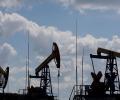
Global energy markets saw a significant correction as oil prices nosedived following Iran's announcement that the Strait of Hormuz has been fully reopened, dismantling the 'war-risk' premium that had gripped the market.

Concerns have emerged about the impact of AI adoption on young workers, particularly those seeking their first job in high-skilled occupations.

'Monsoon is the pran (life) of our water system.' 'A weak monsoon will have a very negative impact on crops and people's lives.'

The intriguing bit is that Trump is likely to attend the talks in Islamabad this weekend -- if he does, it will be the clearest signal yet that the US is ready to exit the war with some sort of win to show, since he cannot afford to go for the talks and return empty-handed, notes Prem Panicker in his must read blog on the Iran War

Signs of a strong pickup in hiring by companies are adding to the rosier outlook for Indian households.

Aviation fuel prices for domestic airlines remain unchanged, providing stability for local carriers, while commercial LPG and 5-kg cylinders see a significant rate hike due to rising international energy costs.

Infosys reported a 20.8 per cent increase in consolidated net profit to 8,501 crore for the January-March quarter of FY26, with revenue from operations rising 13.4 per cent to 46,402 crore. The IT major has guided for a 1.5 to 3.5 per cent revenue growth for FY27, driven by momentum in financial services, utilities, and emerging AI services, despite a volatile macroeconomic environment and geopolitical risks.

'The West Asia or the Gulf crisis has shown that what we develop as national infrastructure when things are not as bad as they could be, we forget to plan for adversities.'

India's electric passenger vehicle market saw an 87.4 per cent year-on-year increase in FY26, reaching 233,246 units, primarily driven by the mid-size SUV segment (20-30 lakh price bracket), while the entry-level segment (sub-10 lakh) experienced a decline.

'After the Galwan clash, the rules of engagement changed with the army commanders allowed to use any means at their disposal as they deem fit for tactical operations.'
India is projected to grow at 6.4 per cent in fiscal year 2025 and 2026, and the country's stable growth is driven by a reform momentum supporting robust consumption growth and a push for public investment, the International Monetary Fund has said. The IMF released its World Economic Outlook (WEO) Update on Tuesday.

'We are profoundly energy-dependent on the Gulf. That dependency must now be redirected towards the United States, because we require American permission to procure oil.' 'We additionally require Iranian permission to acquire oil from that source. So India now has to seek two separate permissions merely to secure its energy supply.' 'Should we be compelled to source from America, or from Venezuela -- which is, in effect, American-controlled supply -- that will inevitably carry a price premium, an elevated shipping cost, and a considerably extended delivery timeline, given the distances involved.'

The purge in Washington does not pause the war. Strikes continue, Hormuz remains closed, and Brent crude is still dancing around $109 a barrel. For India, the command chaos in the Pentagon is another layer of uncertainty piled on five weeks of conflict that was already straining every buffer Delhi has.
